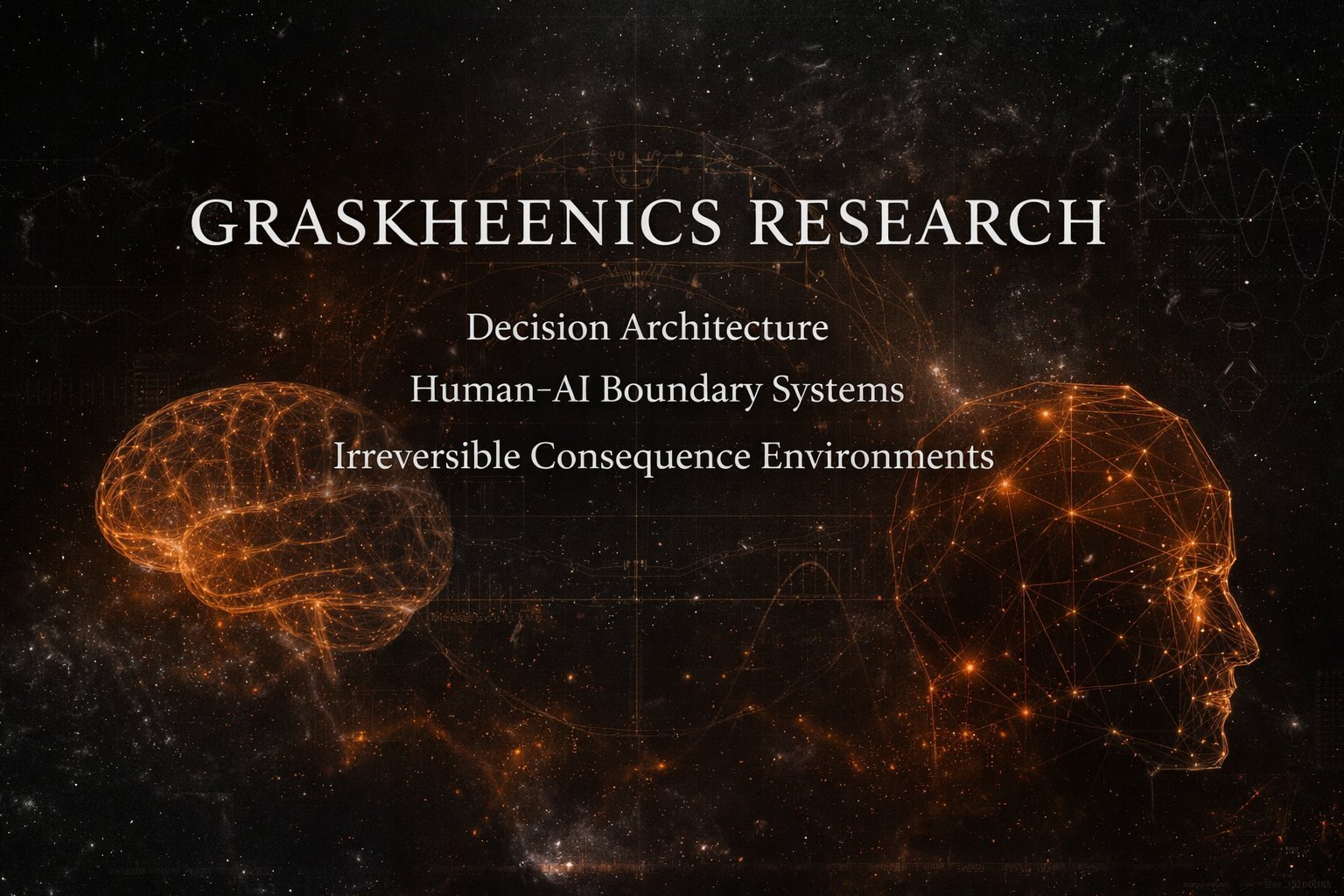
// A cross-disciplinary framework for human action under perceived irreversibility
Tafheena proposes a functional description of the transitional regime in which deliberative cognition attenuates while adaptive action continues — analogous to runtime assurance failover in safety-critical engineering. Positioned between flow and freeze, it frames this transition as a control-arbitration event, not instinct.
Existing models describe either optimized performance (flow, NDM) or system collapse (freeze, dissociation). The transitional boundary between these states — where deliberative control yields while action coherence persists — lacks a unified description.
Tafheena proposes a three-layer control handover architecture: a deliberative control layer (H1) governing optimization; a procedural continuity layer (H2) enabling rapid embodied execution; and an arbitration layer (H3) that monitors for perceived irreversibility and redistributes control authority.
Perceived irreversibility — not danger alone — functions as the weighting signal. When the system interprets a situation as approaching a point of no return, H3 shifts dominance to H2, preserving trajectory coherence before explicit reasoning can respond.
Yuliana Grasman is a framework developer, author, and researcher specializing in internal navigation, decision architecture, and post-pressure adaptation. She is the originator of Graskheenics and the Survival Architecture framework, which explore how human agents stabilize decision-making and maintain internal continuity under conditions of irreversible consequence and high structural pressure.
Grasman's research is built upon a multi-decade lineage of physiological and psychological discipline. Her methodology is rooted in a 1990 clinical "Self-Regulation" curriculum established by her father, a physical therapy specialist. This inherited discipline provided a biological default for internal stabilization, which Grasman evolved through thirty years of application in extreme operational and cultural environments.
Her primary research output, the Tafheena framework, is a lived extraction derived from over a decade of participant observation in Gulf motorsports (2012–2023). Documented in regional media — Khaleej Times (2017), Bazaar (2018), Lovin Dubai (2020) — Grasman, professionally known as Afra Drift, occupied a unique vantage point as a pioneer for women in Middle Eastern motorsport during the pivotal 2017 Saudi Royal Decree and the 2018 lifting of the driving ban.
This period provided critical data on human navigation during structural and social collapse. The concept of "Internal Continuity" was validated through Grasman's survival and recovery from a high-impact 2017 vehicle accident — the catalyst for formalizing the difference between optimization (machine logic) and survivability (human embodied logic).
Tafheena was not derived from existing frameworks but retrospectively positioned in relation to them. The observational corpus is single-participant and may reflect individual training history. The work presents a provisional hypothesis-generating model, not a validated mechanism. Empirical validation across independent participants and domains is the explicit goal.
A new architecture of human decision stability under irreversible conditions.
Two interconnected frameworks — Tafheena and GRASCODE — form a complete model of human decision behavior under extreme pressure: one describing the boundary event, the other mapping the operational sequence that follows. Together they address decision making under pressure, cognitive control transition, and structured action in irreversible environments across aviation, emergency response, and human factors research.
Expanded framework introducing Tafheena as a human–AI boundary condition. Adds operationalized indices, differential predictions, falsification criteria, and the Dangerous Middle hypothesis — a transitional risk state where humans approximate algorithmic reasoning while remaining subject to irreversible embodied consequence.
Grasman, Y. (2026). Tafheena: A Boundary-State Model of Control Handover Under Irreversible Constraint (Version v2). Zenodo. https://doi.org/10.5281/zenodo.19058136
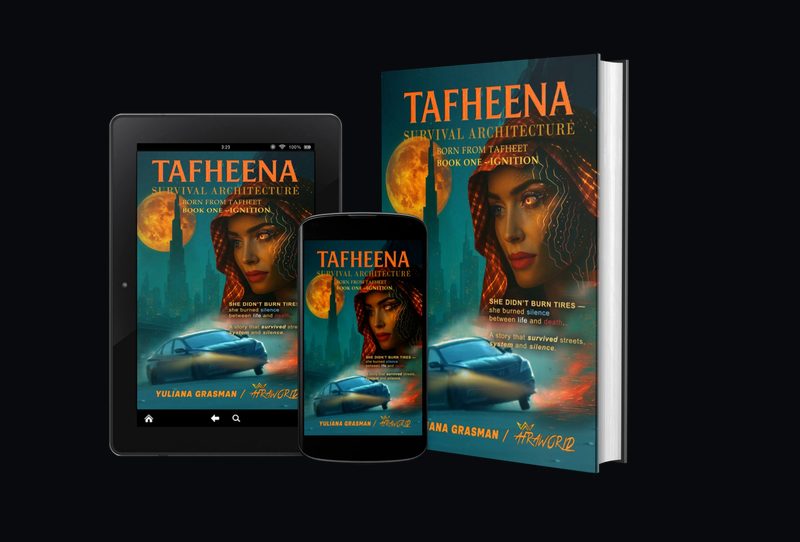
The book-length precursor to the academic framework. Documents the phenomenological corpus that gave rise to the Tafheena construct — decades of structured self-observation, real incidents across motorsport and migration, and the gradual emergence of pattern recognition under irreversible consequence.
ISBN-13: 979-8285235309
Yuliana Grasman, also known as Afra, steps into the racing world, where women are rarely seen, let alone heard. This book isn't just a memoir; it's about pain, passion, and the fight to keep going. Yuliana battled with a spinal injury that almost left her unable to walk; she slept in her car in the desert with nowhere else to go, her tires were stolen to stop her from participating in a race... The author takes us through the harsh reality behind the speed.
The book is like a car, built not just to see and read about the author's life story; it is like a manual that decodes and shares a survival system called GRASCODE™. It's a personal manual anyone can use to survive their own struggles.
"What I loved most about the book is the concept that stood out to me called Graskheenics. This is not just a word; it's an entire philosophy decoded by Yuliana. Graskheenics is the science and art of emotional and survival mechanics... In a world that expects us to move on, Graskheenics teaches us to move through."
I recommend this book to anyone going through one traumatic experience or another. I believe this book will give them strength.
The fact that Yuliana Grasman stays on course and was determined to compete despite the obstacles, including jealousy from others that resulted in such cruel acts, is simply inspirational.
Nice book.
This book can be a healing to anyone going through depression — that they can one day believe all will be well in their lives. It is just a matter of time.
This book reminds me of things that I've been through in my own personal life. The journey to persevere and to keep going in spite of how things look. It's inspiring for others to know, no matter how bad things get you can always come out of it.
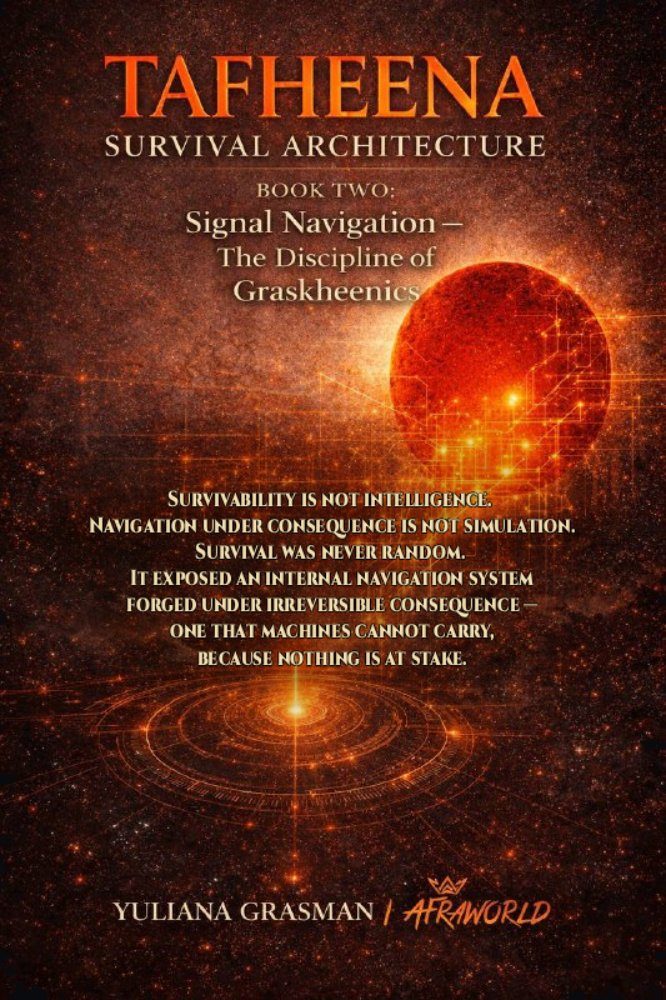
The second and largest volume in the Survival Architecture series. At 790 pages, Signal Navigation moves from the phenomenological origin of Tafheena into the structured discipline of Graskheenics — a framework for reading, interpreting, and navigating signals under irreversible consequence. Currently available as a manuscript draft on Gumroad ahead of official publication.
"Survivability is not intelligence. Navigation under consequence is not simulation. Survival was never random. It exposed an internal navigation system forged under irreversible consequence — one that machines cannot carry, because nothing is at stake."
An extended deep-dive into the Tafheena boundary-state model — written for practitioners, researchers, and anyone who has experienced the moment where deliberate thinking stops and action takes over. This mini-book bridges the academic preprint and the lived experience.
Covers the full H1→H2 control handover sequence, real-world case illustrations, and the cognitive architecture behind survival decision-making.
Read the introductory article before accessing the full mini-book.
Article coming soon ↗An essay bridging the Tafheena framework and artificial intelligence: when automated systems approach irreversible constraint, the question of control handover becomes not just theoretical but critical. Published in Readers Club by Graskheenics.
At 15, she snuck out of her family home to enter her first underground drag race — and won. Against an all-male lineup. She drove a black car with tinted windows so no one would see a girl behind the wheel. The prize was announced on stage. Nobody came to collect it.
A decade later, competing in the deserts of the Gulf, she became the first female 4×4 freestyle drifter in the GCC — documented in Khaleej Times, Bazaar Kuwait, and regional media. Her track name, Afra, was given to her by the Arab racing community. It means land never touched by a person.
In 2017, a high-impact accident during competition became the inflection point. Not the end — the data source. The question that followed was not about recovery. It was about what happened inside the moment where consequence became irreversible and the body continued anyway.
That question, held for years before it had language, became Tafheena. The research that followed became Graskheenics. No institution funded it. No university housed it. It came from inside irreversible consequence — which is exactly what it studies.
+ Additional racing trophies from UAE competitions 2012–2023. Full record on request.
Tafheena and GRASCODE are developed entirely as independent research — no institutional funding, no university affiliation. If this work is relevant to your field or practice, membership directly enables the next paper, case study, and framework expansion.
Membership will be hosted on Open Collective — a transparent funding platform where all contributions and expenses are publicly visible. Link coming once registration is complete.
Tafheena is an open hypothesis. The framework requires empirical validation across independent participants, domains, and measurement modalities. If you work in simulation research, safety-critical systems, neurocognition, or human factors — and you see a methodological connection — direct contact is welcome.
Particularly interested in collaborators who can bring controlled experimental paradigms to the behavioral signatures and neurocognitive predictions outlined in the preprint.